The Order of Suvorov: Three Classes and Command Responsibilities
Who qualified for each class of the Order of Suvorov, which command achievements it recognized and what changed for company commanders in 1943.
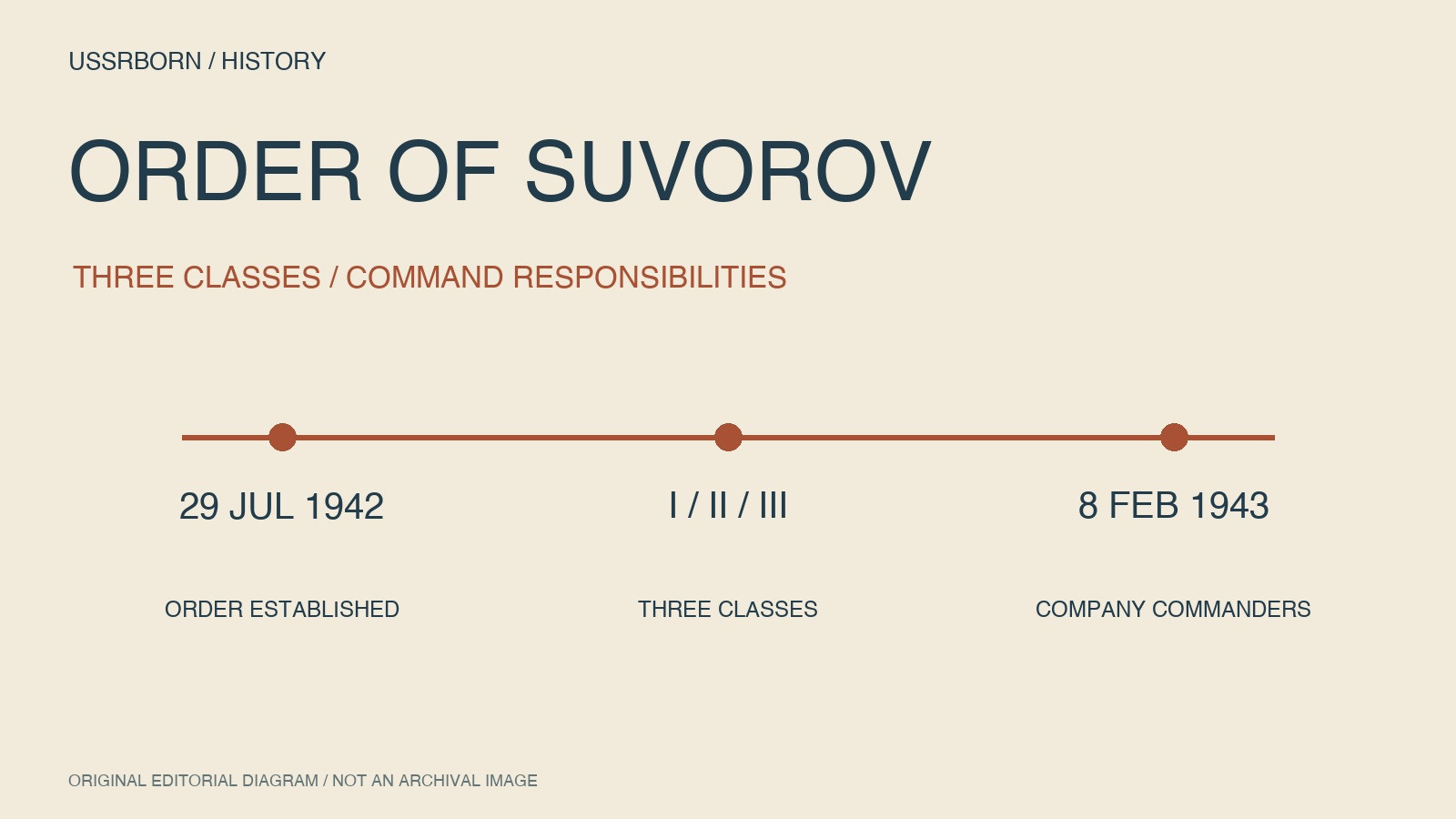
The Order of Suvorov was established on 29 July 1942 with three classes from the outset. Its statute primarily recognized successful command: planning an operation, choosing the direction of an attack, coordinating formations and exploiting a result. The three classes are therefore best understood through the scale of command rather than as successive stages in an individual's record of bravery.
The founding document reveals what the Soviet award system sought to distinguish in a commander's work. Defeating an opponent mattered, but so did the method: timing, manoeuvre and the preservation of one's own forces as an effective fighting organization.
The decree of 29 July 1942
Decree No. 600 of the Presidium of the USSR Supreme Soviet established the Order of Suvorov in its first, second and third classes. The same act introduced the Order of Kutuzov in two classes and the Order of Alexander Nevsky. Each award had its own statute. Their appearance in one decree did not give them identical conditions.
The new order carried the name of the eighteenth-century commander Alexander Suvorov. The Presidential Library's collection shows that Soviet cultural interest in his image preceded the award: a film about Suvorov had appeared in 1940. The wartime decoration connected that historical name with a functioning system for recognizing commanders.
The first class was the highest. However, the statute did not require a recipient to earn the third class, then the second, before becoming eligible for the first. Class was related to command responsibilities and the accomplishment being recognized. Rules governing another three-class decoration cannot simply be transferred to this one.
First class: fronts and armies
The first class was intended for commanders of fronts and armies, their deputies, the relevant chiefs of staff and other senior officers specified in the statute. Its scope was the conduct of a major operation rather than the actions of a single small unit.
The listed grounds included defeating a numerically superior opponent with smaller forces, encircling and destroying an enemy grouping, and correctly selecting the main direction of attack. The statute also recognized concealed manoeuvres that prevented the opponent from regrouping or committing reserves.
These provisions tied a result to the command decisions behind it. Where should effort be concentrated? When should an operation begin? How could an opponent's response be frustrated? The document treated these as matters of achievement, not merely as background to a battlefield outcome.
Its attention to preserving the fighting capacity of Soviet forces also matters. The stated ideal was not simply to attack regardless of the consequences. A successful operation had to be understood in relation to the forces available and the ability to continue fighting.
Second class: corps, divisions and brigades
The second class applied to commanders of corps, divisions and brigades, their deputies and chiefs of staff. The statute described such achievements as breaking through defensive positions and developing the advance, defeating opposing formations, and breaking out of encirclement while preserving troops and equipment.
A deep raid by an armoured formation could also qualify when it assisted the army's wider operation. This provision connected different levels of command. The work of one formation was assessed partly through the contribution it made to a larger plan.
The provision for escape from encirclement is particularly revealing. Recognition was not confined to gaining ground. Bringing an organized fighting force out of a dangerous situation could itself demonstrate effective leadership. Describing the order simply as a decoration for offensive action loses that part of the statute's meaning.
Third class and the February 1943 amendment
The original third-class statute named regimental and battalion commanders, together with regimental chiefs of staff. It covered initiative in directing battle, successful attacks, and holding a position against a stronger opponent before moving to a counterattack.
On 8 February 1943, eligibility was extended to company commanders. The amendment appeared in a decree that also created the third class of the Order of Kutuzov. These were different changes. Suvorov's third class already existed; what changed was the range of command appointments eligible to receive it.
The date therefore matters when reading an award record. The July 1942 provisions and the rules after February 1943 were not quite the same. A reference work that presents a consolidated statute may give the final wording without making the sequence of amendments obvious.
Nor should a simplified list of command levels replace the full legal text. Staff officers and deputies were included in specified categories. The order was concerned with the responsibilities involved in directing military action, not only with the person whose title was formally commander.
The badge and the first first-class awards
The Victory Museum identifies architect Pyotr Skokan as the designer of the insignia. Its description was subsequently revised. The first awards of the first class were made on 28 January 1943, when 23 generals and marshals received it.
Institution and first presentation are separate dates. Establishing a decoration created the legal basis for awards; identifying recipients and approving their recognition was another process. Likewise, a museum object and a statute answer different questions. The badge shows the award's material appearance, while the text sets out the achievements it was intended to recognize.
Reading a recipient's record
To understand a particular award, it helps to compare its class with the recipient's appointment at the time and with the operation described in the supporting documents. The name of the decoration alone cannot reconstruct the circumstances or explain an individual's contribution.
The statute provides a framework for that investigation. The Order of Suvorov combined a remembered commander with a specific vocabulary of military leadership: initiative, coordination, manoeuvre and the preservation of forces. That connection explains its three classes more accurately than imagining them as three successive marks on a career ladder.