Salyut 6 and Progress: How Resupply Extended Spaceflight
Why Salyut 6 needed two docking ports, how Progress differed from Soyuz and how deliveries of supplies supported longer orbital expeditions.
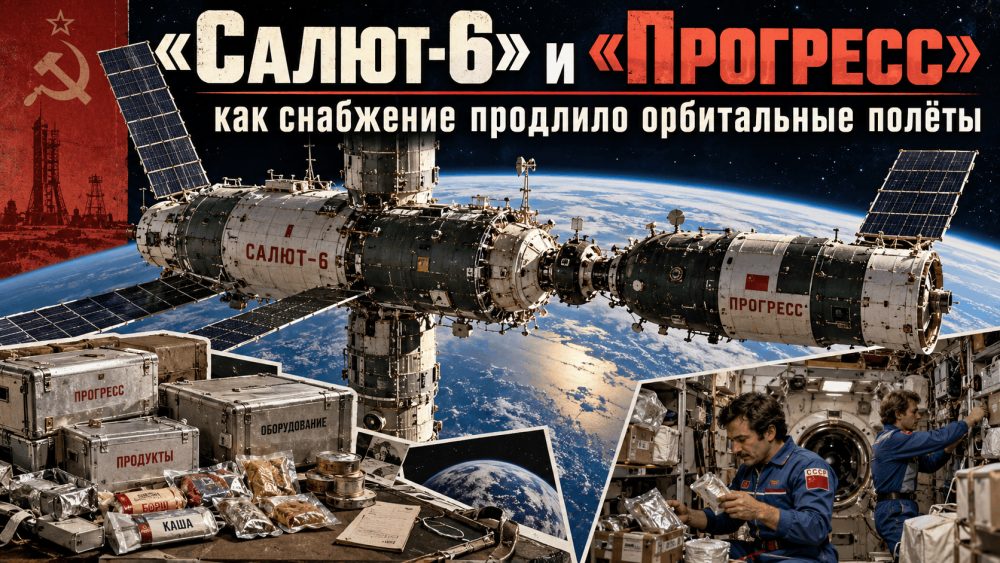
Salyut 6, launched on 29 September 1977, changed the organisation of long-duration spaceflight. With two docking ports, it could receive a Progress cargo vehicle while the crew's transport remained attached. Supplies no longer had to be limited to what could be launched with the station and its occupants. The orbital laboratory became part of a continuing delivery system.
What a second docking port changed
Earlier DOS stations had a single port. The Gagarin Cosmonaut Training Center identifies life-support resources and onboard fuel as limitations on their operation. The experience of Salyut 1 established the importance of the orbital laboratory, but extended operation called for further changes.
Imagine a single berth occupied by the vehicle that must take the residents home. Preparing another shipment on the ground does not solve the problem if there is nowhere for its carrier to dock. A second port removes that constraint: the crew transport can remain attached while another vehicle delivers supplies or visitors. This is a simplified analogy, not an account of a particular redocking manoeuvre.
The extra port alone could not sustain a long expedition. It needed a cargo vehicle, compatible systems, rendezvous control and support on the ground. Their combined operation mattered. The improvement was not merely a larger supply stored inside a spacecraft; it was the ability to replenish supplies during the mission.
Progress and Soyuz had different jobs
Progress drew on Soyuz technology but was not simply a passenger spacecraft filled with boxes. NASA's account describes a major change in layout: systems for delivering propellant and gases took the place of the crew descent module, while the forward compartment carried dry cargo.
Soyuz transported people and provided their return vehicle. Progress delivered consumables and equipment, received unwanted items after unloading and ended its flight through destructive atmospheric reentry. The arrival of a freighter therefore did not provide an additional seat in which a person could return to Earth.
This division of functions suggests a useful way to read station history. Keep three clocks separate: the duration of a person's flight, the time a particular transport vehicle spends in orbit and the lifetime of the station itself. Tables may place all three near one another, but they measure different things. A long-lived laboratory can receive multiple vehicles and crews without sharing their individual flight durations.
The first resupply cycle
The first Progress reached the Salyut 6 programme in January 1978, while Yuri Romanenko and Georgi Grechko were aboard the station. Its work combined delivery for the crew and scientific programme with refuelling, an orbital adjustment and waste removal. NASA describes the fuel transfer in early February and the freighter's final reentry on 8 February.
This was a sequence of tasks rather than one action called delivery. Docking made unloading possible, but moving an instrument container and transferring propellant through technical systems were different operations. After its inbound cargo had been used, the vehicle could also help clear unwanted material from the station.
The NASA anniversary article contains an internal date inconsistency: its introduction gives 20 January for launch, while a later paragraph says 20 February despite describing events in early February. A date should not be copied mechanically from an isolated sentence. The securely established January start is sufficient for understanding the resupply sequence discussed here.
Duration records depended on everyday support
Romanenko and Grechko spent approximately 96 days in flight. NASA compares their achievement with the preceding 84-day mission of the last Skylab crew. Records are memorable, but a list of durations does not explain the food, fuel, equipment condition and continuing research that made a longer stay useful.
Resupply changes planning. If an instrument can arrive later, the research programme does not have to remain entirely confined to the station's original equipment. If consumables can be replenished, part of the constraint shifts from the initial load to the reliability of deliveries. This is an explanation of the organisational effect, not a claim that the engineering limits disappear.
It also changes what counts as an important event. A launch is visually dramatic, while unloading, checking transferred supplies and disposing of unused material may appear routine. Yet an enduring laboratory depends on those repeated operations. The station and its support system must be considered together.
Visitors as well as freighters
The second port could accommodate another crewed transport as well as a cargo craft. A short visiting expedition could arrive while the resident expedition continued its work. The Gagarin Cosmonaut Training Center describes separate preparation for long-duration and visiting crews, and foreign cosmonauts' participation through Intercosmos.
Its summary of Salyut 6 records five main crews, eleven visiting crews and twelve docked Progress vehicles. These figures describe different categories. Adding cargo flights to crew visits and treating the sum as a headcount would produce a meaningless total. A mission count is not a count of unique individuals either.
International visits can be compared with the earlier Apollo-Soyuz mission, but the arrangements were different. A meeting between two spacecraft and a visit to an operating station are distinct forms of cooperation. The station made it possible for a short visit to fit within a longer programme already under way.
A station supported from the ground
The resupply approach continued through subsequent stations, including Mir. This part of the Soviet space programme was concerned not only with new launches but also with making equipment already in orbit useful for longer.
Salyut 6 is important because it makes that change visible. Establishing a laboratory in orbit is only the beginning. Continued work calls for repeated deliveries, unloading, refuelling, maintenance and waste disposal. The second docking port created the opportunity; Progress made it part of an operating cycle.
The result should not be confused with independence from Earth. In one sense it was the reverse: longer missions depended on a more capable connection to ground support. That is the practical significance of the transition from a station carrying a finite initial stock to a station whose supplies could be renewed.