Sputnik 1: the start of the space age
On 4 October 1957 the USSR placed the first artificial satellite of Earth into orbit.
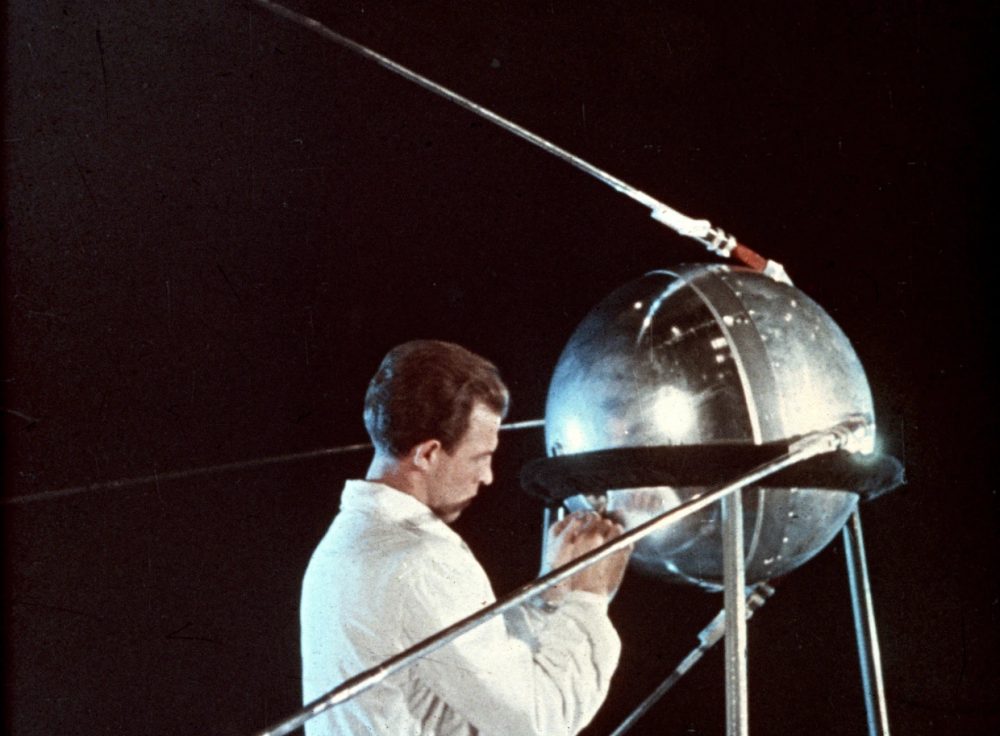
On 4 October 1957 the USSR placed the first artificial satellite of Earth into orbit. Its "beep-beep" was heard around the world — and the space age began.
The signal the whole world heard
On 4 October 1957 a rocket lifted off from the Baikonur Cosmodrome and placed Sputnik 1 — the first artificial satellite of Earth — into orbit. The event is widely regarded as the beginning of the space age.
The craft itself was very simple compared with what would come later. But its main "voice" was a radio signal — a steady "beep-beep" that radio amateurs around the world could pick up. For the first time a human-made object was circling the planet and calling out from space. To millions of people it sounded like the start of a new era.
What it was
Sputnik 1 was a polished metal sphere about 58 centimetres across and roughly 84 kilograms in mass, with four long antennas projecting from its body.
Inside its sealed shell were a radio transmitter, batteries and a thermal-control system that kept the temperature steady. The transmitter worked at frequencies of about 20 and 40 MHz — and it was this signal that the world listened to. There were no complex scientific instruments on board: the whole point was the demonstration itself — to reach orbit and send a signal.
How it orbited
The satellite moved along an elongated orbit and circled the Earth roughly every 96 minutes — a full lap taking about an hour and a half.
The transmitter worked for about three weeks, until the batteries ran down, after which the satellite kept flying in silence. In early January 1958 it entered the dense layers of the atmosphere and burned up, having spent about three months in orbit.
Who built it
Behind the launch was the Soviet rocket programme, led by the chief designer Sergei Korolev. At the time his name was kept secret — publicly he was referred to only as "the Chief Designer". Today Korolev is regarded as one of the key figures in the whole history of spaceflight.
The satellite was carried into orbit by a rocket built on the basis of the R-7 intercontinental ballistic missile. That is an important detail — and it explains why the launch mattered far beyond science.
More than science: the military subtext
The same rocket that carried a peaceful sphere with a transmitter into orbit could also carry a nuclear warhead. The launch of Sputnik showed the whole world, in plain terms, that the USSR had rockets capable of reaching another continent.
So behind the scientific triumph lay a strategic message too. At the height of the Cold War that was no less important than the fact of reaching space itself.
The "Sputnik shock" in the United States
In the United States the launch was felt as a jolt — it was even called the "Sputnik shock". Many had been certain that Americans would be first into space, and the unexpected Soviet lead caused real alarm.
The response was sweeping: the US poured money into science and education, and soon, in 1958, the space agency NASA was created. Sputnik sharply accelerated the space race between the two superpowers.
What came next
Just a month later, on 3 November 1957, Sputnik 2 went into orbit — this time with a living passenger on board, the dog Laika. The space race was gathering pace, and only a few years later, in 1961, the first human would fly into space: Yuri Gagarin.
Why it matters
Sputnik 1 is the starting point of the space age.
- For the first time a human-made craft reached Earth orbit — humanity had stepped into space.
- The launch was both a scientific breakthrough and a show of strength: it demonstrated what Soviet rocketry could do.
- The word "sputnik" itself (Russian for "companion" or "fellow traveller") entered many languages and became a symbol of the dawn of the space era.
Related
- Yuri Gagarin: the first human in space — the first human in space, four years later.
- Valentina Tereshkova: the first woman in space — the first woman in orbit.
- Sergei Korolev: the Chief Designer — the man who built the rocket for Sputnik.
- Laika: the first living creature in orbit — the second launch, paid for with a life.
Sources
The facts in this article can be verified against authoritative sources:
- NASA, "Sputnik and the Dawn of the Space Age": https://www.nasa.gov/history/dawn-of-the-space-age/
- NASA, NSSDCA catalog, "Sputnik 1": https://nssdc.gsfc.nasa.gov/nmc/spacecraft/display.action?id=1957-001B
- Encyclopædia Britannica, "Sputnik": https://www.britannica.com/technology/Sputnik
- U.S. Department of State, Office of the Historian, "Sputnik, 1957": https://history.state.gov/milestones/1953-1960/sputnik
- Library of Congress, "Sputnik and the Space Race: 1957 and Beyond": https://guides.loc.gov/sputnik-and-the-space-race
Where assessments of the event's significance differ (a scientific triumph, or above all a military demonstration), we show both sides.