Valery Brumel: Six World Records and Olympic Gold in 1964
How Brumel won Olympic gold despite matching John Thomas’s height: Rome 1960, six world records and the decisive failed attempts in Tokyo.
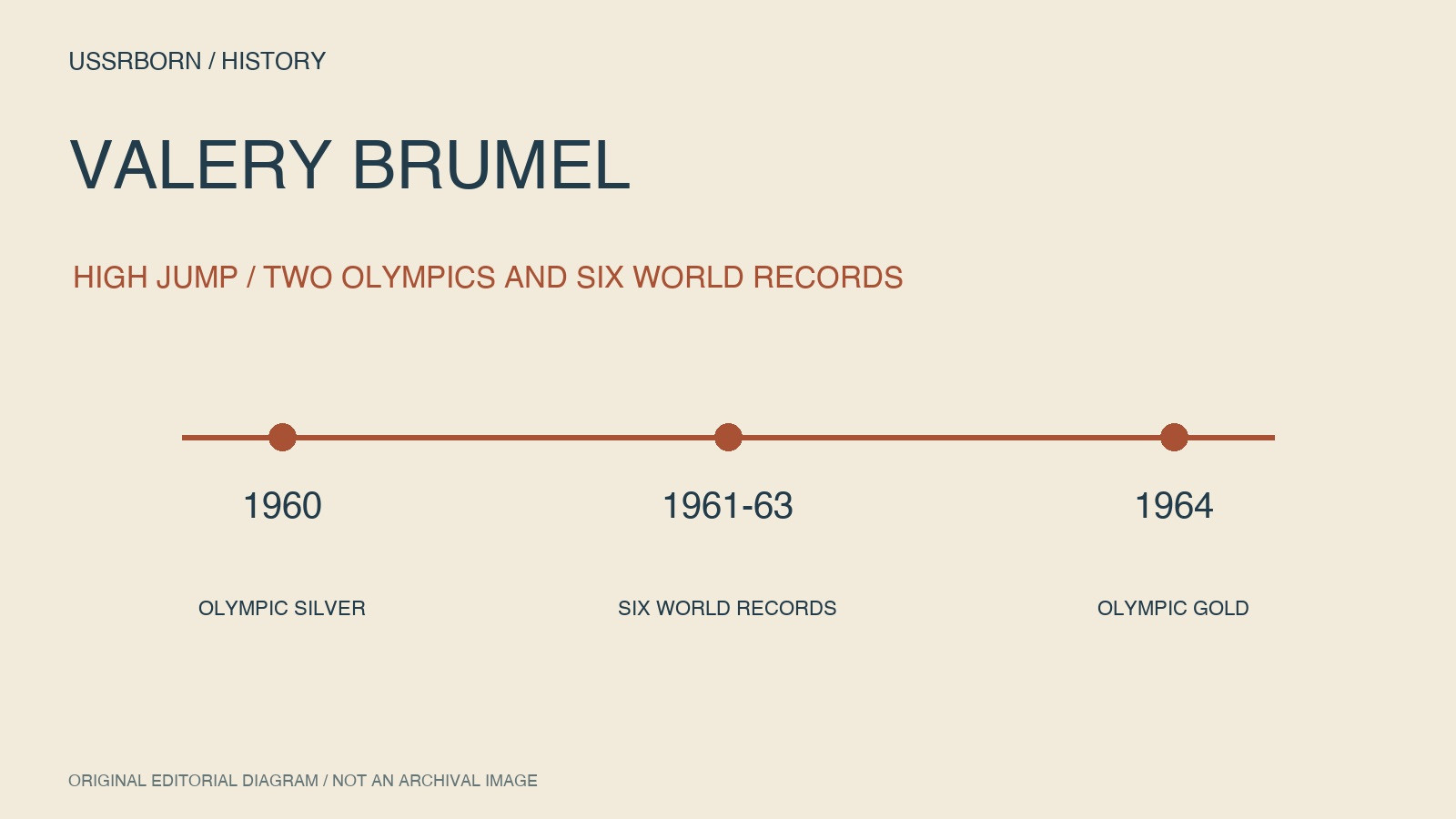
Valery Brumel won the Olympic high jump title in Tokyo in 1964 with 2.18 metres. That was below his own world record, and American John Thomas cleared exactly the same height. The gold medal was decided by failed attempts: Brumel had made fewer errors on the way to his final successful clearance.
The result illustrates the distinction between a record and a victory. A record measures an athlete's highest achievement. An Olympic title depends on what happens in one particular competition, including attempts that a simple list of finishing heights can conceal.
Rome: equal heights, different medals
At the 1960 Olympics, eighteen-year-old Brumel finished second. In the final on 1 September, he and fellow Soviet jumper Robert Shavlakadze cleared 2.16 metres. Shavlakadze succeeded on his first attempt; Brumel needed two. Shavlakadze took gold, while John Thomas placed third with 2.14. These results are recorded by Olympedia.
Identical final heights therefore did not mean identical placings. To understand the result, a reader needs to know how each athlete reached that height. In Rome, the attempts at the last successful height separated the two Soviet competitors.
Six world records
Olympedia's biography lists six world records for Brumel between 1961 and 1963: 2.23, 2.24 and 2.25 metres in 1961; 2.26 and 2.27 in 1962; and 2.28 in 1963. He also became European champion in 1962.
World Athletics highlights the technique behind those performances. Brumel used the straddle, before the widespread adoption of the Fosbury flop. The familiar modern image of a jumper passing over the bar backwards should therefore not be projected onto his performances. Those successive record heights were achieved with a different method of clearing the bar.
Tokyo: why Brumel won
The Olympic final took place on 21 October 1964. Brumel and Thomas both cleared 2.18 on their first attempt, then both failed at 2.20. It is consequently incorrect to explain the result by saying Brumel needed fewer attempts at the winning height.
In the competition record reproduced by Olympedia, Brumel had two failures through his last successful height, both at 2.14. Thomas had four: the same two at 2.14, plus one each at 2.12 and 2.16. Brumel's lower failure count gave him first place. Another American, John Rambo, took bronze with 2.16.
Beyond the record table
In October 1965, Brumel suffered a serious leg injury in a motorcycle accident. After lengthy treatment he returned to jumping, but did not regain his previous level. His life continued beyond elite competition, and he later became a writer.
Brumel's career offers a useful way to read sporting achievements. Six world records chart the rise of his best performance; two Olympic finals reveal the importance of individual attempts. Equal heights left him with silver in Rome. A cleaner competition brought him gold in Tokyo.