Andrei Sakharov: from the hydrogen bomb to the fight for human rights
The physicist who created the Soviet hydrogen bomb and then became the USSR's most famous dissident and a Nobel Peace Prize laureate. The story of "the conscience of mankind."
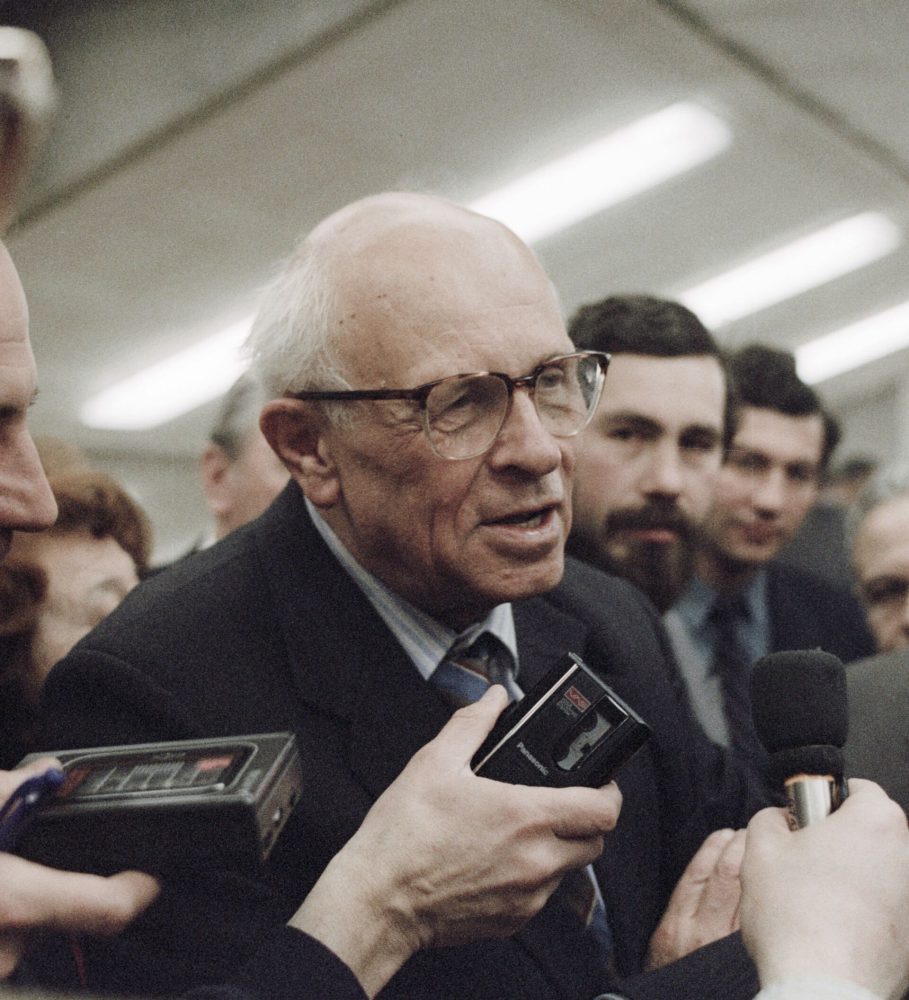
From the bomb to conscience
Andrei Sakharov lived two lives in one. First he was a brilliant physicist, "the father of the Soviet hydrogen bomb." Then he became the Soviet Union's most famous dissident, a defender of human rights and a Nobel Peace Prize laureate. He was called "the conscience of mankind."
The road from a secret weapon to an open struggle for freedom is a rare and courageous one. Sakharov paid for it with persecution, the loss of all his honours and years of exile.
A young genius
Andrei Dmitrievich Sakharov was born on 21 May 1921 in Moscow, into a family of the Russian intelligentsia; his father was a well-known physics teacher. Andrei brilliantly finished the physics faculty of Moscow State University (in 1942, with distinction, already in wartime evacuation). His teacher was the distinguished physicist Igor Tamm. In 1948 Sakharov was brought into the group developing nuclear weapons.
The hydrogen bomb
Sakharov proposed an original design for a hydrogen bomb — the so-called "Layer Cake" (alternating layers). On 12 August 1953 the USSR tested its first hydrogen bomb, based on this idea. Later he became one of the authors of a more advanced, "two-stage" design, tested in 1955.
Recognition came early and generously: at the age of 32 Sakharov became the youngest member ever elected to the USSR Academy of Sciences, and he received the title of Hero of Socialist Labour three times. For almost two decades he worked under the strictest secrecy.
An awakening
Gradually Sakharov grew ever more alarmed at the consequences of nuclear testing — above all radioactive contamination. In 1961 he spoke out against a plan to test an ultra-powerful 100-megaton bomb in the atmosphere. His efforts contributed to the 1963 treaty banning nuclear tests in three environments.
In 1968 Sakharov published in the West his famous essay "Reflections on Progress, Peaceful Coexistence, and Intellectual Freedom." In it he called for the reduction of nuclear weapons and criticized the suppression of dissent. After this he was removed from secret weapons work.
A dissident
Sakharov became an open human rights defender. In 1970 he was among the founders of the Committee on Human Rights in the USSR. He wrote appeals on behalf of more than two hundred prisoners, stood vigil outside closed courtrooms and demanded change. In 1972 he married a fellow human rights activist, Yelena Bonner.
The authorities responded with growing pressure. The head of the KGB, Yuri Andropov, called Sakharov the "number one enemy" within the country.
The Nobel Peace Prize
In 1975 Sakharov was awarded the Nobel Peace Prize — for the defence of human rights. The authorities would not let him travel to Oslo for the ceremony, and his Nobel lecture, "Peace, Progress, Human Rights," was read by his wife, Yelena Bonner. In it he called for an end to the arms race, for care of the environment and respect for human rights, named political prisoners and said he shared the prize with them.
Exile in Gorky
In January 1980, after Sakharov publicly condemned the Soviet intervention in Afghanistan, he was exiled without any trial to the city of Gorky (now Nizhny Novgorod), which was closed to foreigners. He was stripped of all his honours. In 1984 his wife was sent into exile with him. The couple were watched by the KGB.
But it proved impossible to silence Sakharov. His worldwide fame partly protected him: he went on writing and giving interviews to Western journalists. To get medical treatment for his wife he held exhausting hunger strikes — and succeeded in having Bonner released for heart surgery abroad.
Return and final years
In December 1986 the new Soviet leader Mikhail Gorbachev, who had launched perestroika, personally telephoned Sakharov and allowed him and his wife to return to Moscow. It became one of the symbols of the changes now coming.
Sakharov's final years were turbulent. In 1989 he was elected to the new parliament — the Congress of People's Deputies — where he became one of the leaders of the democratic opposition. He was not afraid to criticize even Gorbachev, insisting that the reforms must go further — as far as abolishing the Communist Party's monopoly on power.
Andrei Sakharov died on 14 December 1989, just hours after a session of the Congress. He lived to see the fall of the Berlin Wall. And what he had fought for — the abolition of the constitutionally enshrined monopoly of the Party — was carried out in March 1990.
Legacy
Sakharov's name became a symbol of courage and conscience. As early as 1985 the European Parliament established the Sakharov Prize — "for Freedom of Thought," awarded for contributions to the defence of human rights. His widow, Yelena Bonner, continued her human rights work until her own death in 2011.
In the USSR he was officially branded a renegade; in the world he was honoured as a hero. Today Sakharov is most often spoken of with respect: as a man who, knowing the price of fear, chose conscience.
Frequently asked questions
Who was Andrei Sakharov? A Soviet nuclear physicist (1921–1989), "the father of the Soviet hydrogen bomb," who became a human rights defender and dissident; a Nobel Peace Prize laureate in 1975.
What did he win the Nobel Peace Prize for? For his struggle for human rights and against the arms race. He was not allowed to attend the ceremony in Oslo — his wife read his lecture.
Why was he exiled? For publicly condemning the Soviet intervention in Afghanistan he was exiled without trial to the closed city of Gorky (1980–1986).
Did he make the bomb or fight for peace? Both — that is the paradox of his life: the creator of the hydrogen bomb later became the country's most famous fighter for peace and human rights.
Related
- The Cold War — the arms race whose restraint Sakharov called for.
- The dissolution of the USSR (1991) — the changes he lived to see and helped bring closer.
- Vladimir Vysotsky — another voice the authorities tried to silence.
- Alexei Leonov — the cosmonaut to whom (together with Sakharov) Arthur C. Clarke dedicated his book.
Sources
The facts in this article can be verified against authoritative sources:
- Encyclopædia Britannica, "Andrey Sakharov": https://www.britannica.com/biography/Andrey-Sakharov
- Wikipedia, "Andrei Sakharov": https://en.wikipedia.org/wiki/Andrei_Sakharov
- NobelPrize.org, "Andrei Sakharov – Biographical" (1975): https://www.nobelprize.org/prizes/peace/1975/sakharov/biographical/
- Atomic Heritage Foundation, "Andrei D. Sakharov": https://ahf.nuclearmuseum.org/ahf/profile/andrei-d-sakharov/
- European Parliament, "Andrei Sakharov" (Sakharov Prize): https://www.europarl.europa.eu/sakharovprize/en/the-prize/andrei-sakharov