The Austrian State Treaty of 1955: Withdrawal and Neutrality
How the Moscow memorandum, the May 1955 treaty, troop withdrawal and Austria’s neutrality law fit together: documents and four key dates.
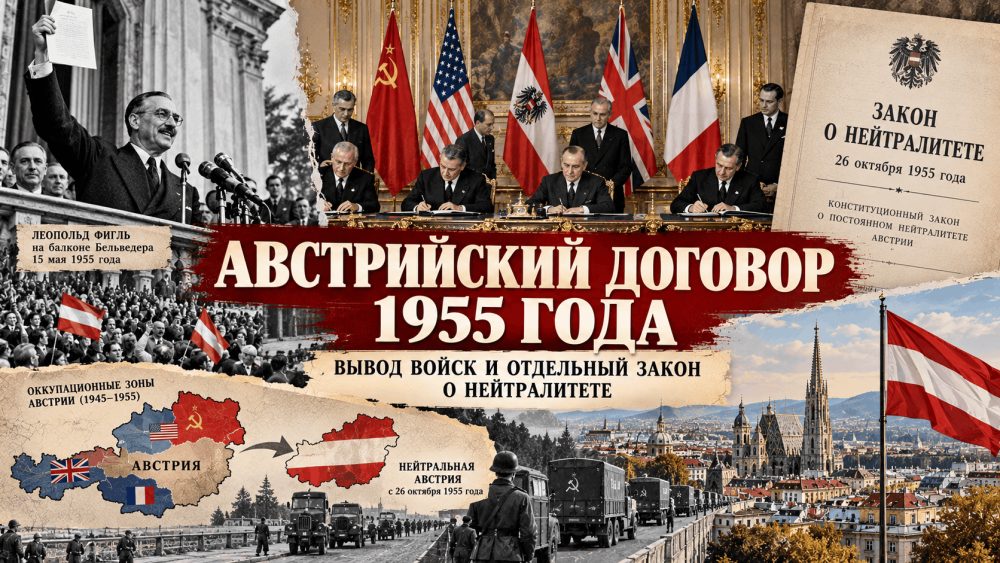
On 15 May 1955, the Soviet Union, the United States, Britain, France and Austria signed the State Treaty for the Re-establishment of an Independent and Democratic Austria at Vienna's Belvedere Palace. It opened the way to ending the occupation regime. The treaty did not, however, contain a provision establishing permanent neutrality. Austria adopted the relevant constitutional law on 26 October that year.
The decisions were politically connected, but they had different legal forms and dates. Understanding Soviet participation requires keeping those distinctions visible. Negotiations, signature, entry into force, troop withdrawal and the adoption of domestic legislation were successive parts of the settlement, not one event described by interchangeable names.
Why a settlement took so long
After the Second World War, Austria was occupied by four powers. The Austrian Parliament's historical account links the prolonged difficulty of reaching a settlement to the Cold War and the participants' different interests. The Soviet Union wanted Austria to remain outside a Western military alliance; the Western powers wanted a democratic state with a Western orientation.
Economic matters also required agreement, including German assets and Soviet property claims. Restoring sovereignty involved more than deciding which troops would leave. The negotiators had to address consequences of the post-war administration of property as well.
That combination helps explain why the settlement cannot be reduced to a successful ceremony. Signature followed agreement on a package of obligations. Political assurances about Austria's future position and economic conditions were connected elements of the negotiations, but they were not identical questions.
A promise about future policy could help make a treaty possible without becoming an article of that treaty. This distinction is central to the relationship between the State Treaty and neutrality.
The Moscow memorandum and the May ceremony
The Austrian Parliament identifies the Moscow memorandum of 15 April 1955 as an important step. Austria's intention to adopt permanent neutrality formed a significant part of the political understanding reached with the Soviet Union. The memorandum did not replace either the subsequent international treaty or Austria's later constitutional law.
The treaty was signed at the Belvedere on 15 May. The United States documentary collection Foreign Relations of the United States, or FRUS, records the participation of the four powers' foreign ministers and high commissioners, together with Austria's foreign minister. Soviet agreement was necessary, but the resulting instrument was a multilateral settlement rather than a separate Soviet-Austrian treaty.
The phrase “State Treaty” refers to this particular document concerning Austria's restoration. Its title cannot tell us the content of every accompanying political assurance. To identify the obligations actually written into it, the treaty must be distinguished from statements made before or during the signing ceremony.
Signature and entry into force were different milestones
The treaty entered into force on 27 July 1955. The interval after the May ceremony allowed the procedures necessary to bring the international agreement into effect. Calculating deadlines established by the treaty from 15 May would therefore use the wrong starting point.
Article 20 linked the termination of the Allied control machinery to entry into force. It also addressed the end of inter-Allied administration in Vienna and the termination of the agreement on occupation zones after evacuation. These were related changes, but the text did not treat them as a single action.
That structure gives a more precise meaning to the restoration of sovereignty. Ending the authority of occupation institutions and physically moving military personnel and equipment were different tasks. A legal change could take effect at a defined moment, while the withdrawal required arrangements over time.
The distinction also prevents an evocative photograph of a signing ceremony from carrying more historical weight than it can bear. The photograph documents signature; the treaty text establishes when its provisions began to operate.
What Article 20 required
The text of Article 20 is available in Austria's official legal information system. It provided for the withdrawal of the forces of the Allied and Associated Powers and members of the Allied Commission within 90 days of entry into force, as far as possible, and in any event no later than 31 December 1955.
Both qualifications matter. Reporting only “within 90 days” leaves out the wording concerning practicability and the final outer limit. The provision covered the occupying powers collectively, rather than Soviet troops alone.
Certain rights and immunities continued until withdrawal was completed. The article also dealt with the return of unspent occupation funds and requisitioned Austrian property, subject to qualifications concerning other treaty provisions. Ending occupation involved accounts and property transfers alongside the departure of military units.
A contractual timetable is not, on its own, evidence of the departure date of the last soldier from a particular garrison. Establishing that would require a separate record of the actual movement. The treaty tells us what the parties undertook to do and how the transition was framed.
Neutrality was enacted separately on 26 October
On 26 October 1955, Austria's National Council adopted the constitutional law on permanent neutrality. It provided that Austria would not join military alliances or permit foreign military bases on its territory. This domestic act, rather than a missing article of the State Treaty, formally expressed the undertaking.
The difference in legal form does not remove the political connection. The Austrian Parliament describes the promise of neutrality as a condition that helped make the settlement possible. Political dependence, however, is not the same as inclusion of a clause in the treaty signed in May.
FRUS also preserves evidence of different diplomatic interpretations. According to the American record, Molotov spoke at the ceremony of complete American acceptance of Austrian neutrality, while Dulles characterised the American position as agreement in principle. This is the American side's account of the difference, not an impartial transcript of every private negotiation.
The episode illustrates why a signed instrument, an accompanying assurance and a diplomat's description of another government's position should be read separately. They can illuminate the same negotiation without saying exactly the same thing.
Four dates that clarify the settlement
Four milestones provide a useful framework: the Moscow memorandum on 15 April, signature of the State Treaty on 15 May, its entry into force on 27 July and the neutrality law on 26 October 1955. Each answers a different historical question.
The Soviet role included negotiating the conditions, joining the multilateral agreement and ending its own occupation presence as part of the settlement. Austria's experience in 1955 shows how an international treaty, troop withdrawal and domestic constitutional legislation could work together while remaining distinct documents and actions.