The USSR and the Universal Declaration: The 1948 Vote
How the USSR voted on the Universal Declaration of Human Rights on 10 December 1948: the UN record, Soviet arguments and adoption versus signature.
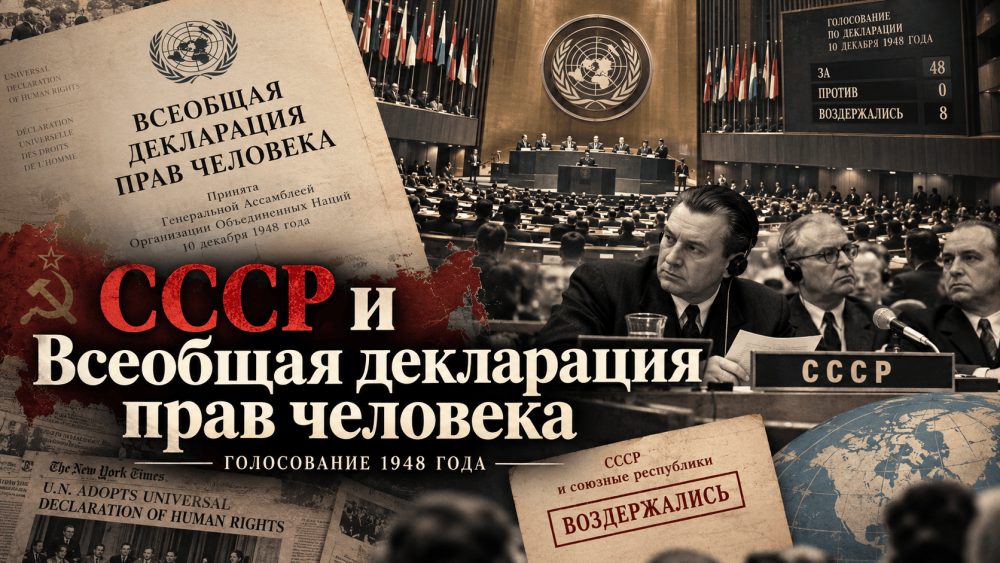
On 10 December 1948, the UN General Assembly adopted the Universal Declaration of Human Rights with 48 votes in favour, none against and eight abstentions. The Soviet Union was among those abstaining. That was neither a negative vote nor support for the final text. The meeting record allows the result to be distinguished from the arguments that preceded it.
The decision in Paris
The Declaration was adopted during the General Assembly's third session in Paris and is associated with resolution 217 A (III). The record of the 183rd plenary meeting sets out the roll-call vote on the draft as a whole after consideration of individual provisions.
The abstaining members were the Byelorussian SSR, Czechoslovakia, Poland, Saudi Arabia, the Ukrainian SSR, the Union of South Africa, the USSR and Yugoslavia. A shared voting choice does not establish a shared motive. Their positions should not be collapsed into a single explanation simply because they appear in the same list.
The Byelorussian and Ukrainian republics were separate UN members. Our article on the USSR and the founding of the United Nations explains that arrangement. In the 1948 record, their votes are listed separately from the Soviet Union's vote and count as separate entries.
Abstention was not a vote against
The statement that the USSR voted against the Declaration misreports the final roll call. No negative votes were cast on the document as a whole. Describing the outcome as unanimous support by everyone would also conceal the abstentions.
The precise formulation preserves both facts: the document passed without a vote against it, while eight members abstained. This is more than a matter of arithmetic. A delegation can decline to endorse an entire document while recognising merit in some of its provisions.
Individual articles and amendments were also put to votes. Several different results consequently appear close together in the meeting record. Taking a tally for one provision and presenting it as the outcome for the whole Declaration would produce a false account, even if the numbers had been transcribed accurately.
The document itself marks the transition to the final roll call. That procedural wording is as important as the figures. It identifies what the delegates were deciding at that particular point.
The Soviet delegation's stated arguments
Andrei Vyshinsky acknowledged positive elements in the draft but described it as unsatisfactory. He argued that certain provisions affected states' sovereign rights and conflicted with non-interference. In his account, rights needed concrete guarantees adapted to national conditions rather than proclamation alone.
These were arguments advanced by the Soviet representative. They should be attributed as such, not presented as conclusions established by the record itself. A transcript documents what a participant said; it does not automatically validate the participant's assessment of the disputed text.
Vyshinsky also recalled the Soviet proposal to postpone adoption until the following session and the intention to submit amendments if postponement was rejected. Soviet involvement therefore consisted of more than a final answer in a roll call. It included participation in debate, efforts to alter the document and a decision not to endorse the completed version.
Keeping those stages distinct avoids two opposite errors: imagining that the USSR had no involvement in the process, or treating participation in drafting as proof of support for the final outcome.
Civil liberties and social rights appeared together
The adopted Declaration covered several groups of rights. Alongside prohibitions on slavery and torture, judicial guarantees and freedoms of thought and expression, it addressed work, social security, education and cultural participation. A simple contrast between an exclusively political document and Soviet concern with social questions does not match the final text.
Article 23 concerns work, employment conditions, protection against unemployment and trade unions. Article 24 addresses rest and reasonable limits on working hours. Article 26 concerns education. Those provisions are part of the Declaration regardless of an individual delegation's voting choice.
The existence of a provision does not establish how a right was implemented in a particular country. That question calls for separate evidence about legislation and practice. Comparison with the Soviet Constitution of 1936 is useful when this distinction is maintained: wording can be compared without assuming equivalent implementation.
Nor does a country's support for a declaration demonstrate that it met every stated standard. The content of a norm, a diplomatic vote and domestic conduct are separate subjects of inquiry. Treating them as interchangeable makes historical judgment less reliable.
Why “signed” is the wrong procedural shortcut
In 1948, the General Assembly adopted a declaration through a resolution. This was not a ceremony of treaty signature followed by national ratification. The familiar question “Why did the USSR not sign the Declaration?” is therefore better framed as a question about its abstention in the vote.
The UN legal library's preparatory history shows that different forms were discussed: a declaration, treaty commitments and measures of implementation. Their distinction formed part of the work itself, rather than being a technicality introduced by later commentators.
This does not mean that a declaration has no significance. It means that its adoption must be described using the procedure that actually occurred. Voting for a resolution, signing a treaty and ratifying a treaty are different acts. Transferring language from one to another can attribute a decision to a state that it never made in that form.
The safest starting point is the document's identifier and meeting record. They tell the reader which institution acted, what text was before it and how the outcome was recorded.
Three sources answer three questions
Read the final text alongside the voting record and delegates' speeches. The text establishes the content of the standards. The roll call identifies the members' choices. The speeches document their public explanations. None alone supplies the whole history.
Later disputes about human rights in Soviet international relations are discussed in our article on the Helsinki Final Act of 1975. The biography of Andrei Sakharov introduces a different, personal history of rights advocacy. These are related subjects, but neither should be substituted for the specific setting of December 1948.
The result can be stated without forcing it into a misleading binary. The Soviet Union participated in discussion, criticised the draft and abstained on the final text. The Declaration was adopted without a negative vote. Retaining those distinctions gives a clearer account than compressing the episode into either complete endorsement or a vote of rejection.