The Druzhba Oil Pipeline: Construction, First Deliveries and the 1964 Opening
Who built Druzhba, why oil reached Bratislava before the formal opening and how the first construction phase differed from the 1974 expansion.
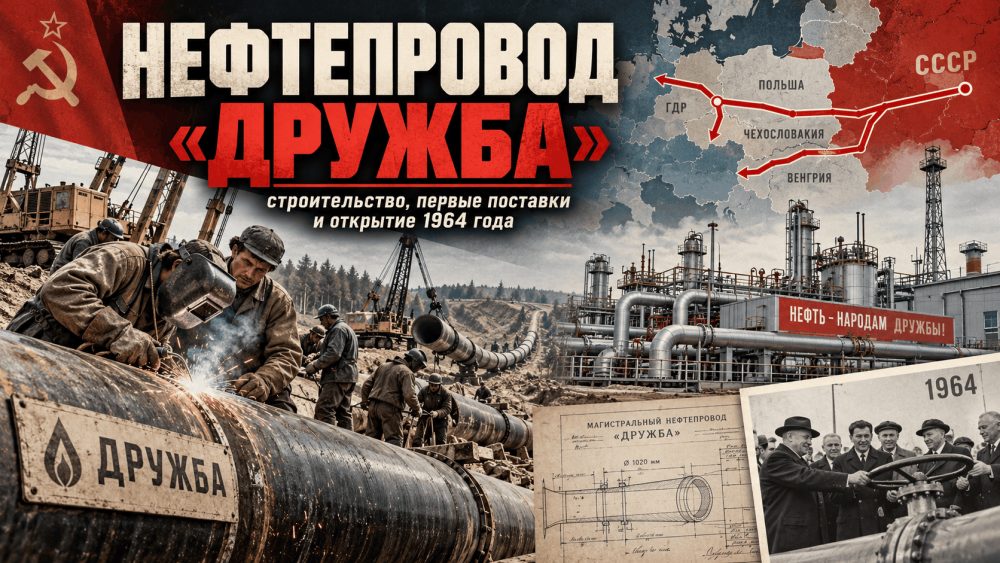
The Druzhba oil pipeline entered service in stages. Oil reached Bratislava in 1962, while the system's ceremonial opening took place on 15 October 1964. These dates describe different events: the beginning of deliveries on a particular route and the completion of a major phase of international construction.
The project connected Soviet oil production with refineries in European socialist countries. Its history involves more than the length of the pipe. Work on opposite sides of borders had to produce sections that could operate together. A continuous flow depended on separate national construction programmes becoming a connected transport system.
An agreement and a construction problem
Historical material from the operator MERO and the Encyclopedia of Modern Ukraine places the construction agreement in 1959. The participants were the Soviet Union, Poland, East Germany, Czechoslovakia and Hungary. The first phase was built between 1960 and 1964.
Those names describe the political map of the period. Czechoslovakia was then a single state, and East Germany participated separately in the agreement. Replacing the original participants with a list of present-day countries would obscure the setting in which the project was negotiated.
A pipeline is a longer commitment than a single shipment. Its route links suppliers and receiving facilities through fixed infrastructure. Manufacturing pipe is only part of the job: a route must be prepared, sections assembled, pumping arranged and receiving facilities made ready. An international project also needs neighbouring sections to reach compatible stages of completion.
This helps explain why a construction period and a first-delivery date need not coincide. The project can still be unfinished as a whole while a usable chain of completed sections already connects a supplier to one refinery.
A shared project with different responsibilities
MERO's historical account describes construction as a distributed undertaking. Each country built its own section, while equipment came from several participants. Czechoslovakia supplied pipes and fittings, for example, and Hungary supplied automation and communications equipment. A common project name did not mean a single building site or contractor.
The division of work made technical coordination essential. Pipes had to connect, valves had to suit the operating conditions, and information about individual sections had to reach the people managing the flow. A finished stretch of pipe alone could not establish that the complete route was ready.
Unlike a railway train, oil in a pipeline has no locomotive pulling it onwards. Pumps maintain movement, and pressure must be controlled. Pumping stations and communications therefore belong to the transport system itself. They are not merely conveniences placed beside the route after the main engineering work is done.
The physical pipe can dominate photographs because it is visible and recognisable. Understanding what made it useful requires looking beyond that object to the equipment and coordination that turned connected steel sections into a working means of transport.
What happened in 1962, 1964 and 1965?
MERO dates the first delivery to the Bratislava refinery to February 1962. This was an operating connection before the initial international construction programme had reached its ceremonial conclusion. Opening sections progressively made it possible to use a route once its necessary links were available.
The Russian Museum of Ethnography's catalogue gives 15 October 1964 as the system's formal opening date. It describes an event at a different scale. Answering “1964” to the narrower question of when oil first reached Bratislava would erase two years of earlier deliveries there.
In October 1965, the route was extended to the Litvinov area, serving the refinery at Zaluzi u Mostu. That destination brings a third date into the story. A single anniversary is convenient, but it cannot stand in for the sequence of individual connections.
The principal milestones are therefore:
- 1959: the participating countries reached their agreement.
- 1960 to 1964: construction of the first phase.
- February 1962: first deliveries to Bratislava.
- 15 October 1964: the system's ceremonial opening.
- October 1965: extension of the delivery route to Litvinov.
The distinction is practical as well as chronological. A ceremony can mark the achievement of a shared programme, while a refinery's history records the moment a particular supply connection became useful. Both belong in the history of Druzhba.
A second line and a longer construction history
The Encyclopedia of Modern Ukraine dates completion of the second parallel line to 1974. Construction history thus continued beyond the opening ceremony of 1964. An established route could be enlarged through an additional pipeline.
A parallel line is a separate pipe along the relevant direction. It is not a patch on the original line, nor does the term simply mean pumping the existing pipe harder. Adding a line requires further construction and expands the physical transport infrastructure.
Its completion date cannot, by itself, establish how much oil moved in every subsequent year. Design capacity, actual throughput and the amount received by a particular country are different measurements. A figure for one destination should not be presented as the volume carried by the entire network.
The same caution applies to time. Historical descriptions of the system are evidence for the period they cover. They should not be silently repurposed as statements about present-day routes, ownership or deliveries.
Reading a photograph from 1973
The Russian Museum of Ethnography holds a 1973 photograph by I. Sverida associated with the meeting of the Druzhba oil pipeline, the Bratstvo gas pipeline and the Mir electricity transmission line. The catalogue offers an example of infrastructure names becoming part of the public language of the period.
It is not a photograph of the 1964 opening: the image was made nine years later. Nor does the grouping of the three names mean that the projects formed one pipe. Oil, gas and electricity travelled through different technical systems, brought together in the catalogue subject and its symbolic presentation.
Druzhba is best understood at both scales: an international undertaking with a shared name, and a sequence of specific sections, deliveries and expansions. Keeping those scales visible preserves the importance of the anniversary without allowing it to replace the history of how the pipeline actually entered service.