The Soviet New Year Tree: The 1935 Return and the 1947 Decree
How the New Year tree returned to Soviet schools, what a 1937 guidebook covered and why the December 1947 decree made 1 January 1948 a day off.
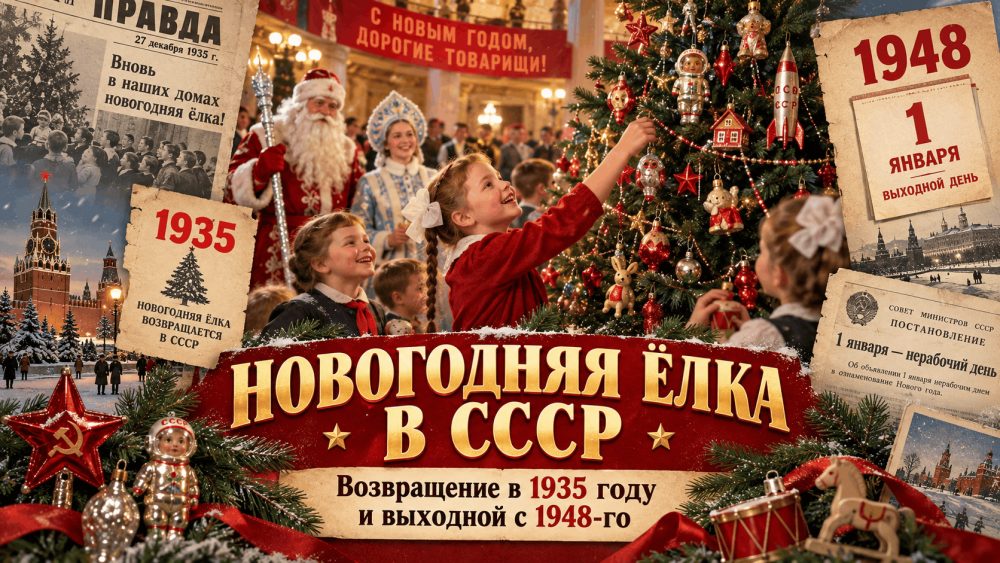
The decorated New Year tree returned to Soviet public life in late December 1935. A Pravda article by Pavel Postyshev on 28 December marked the change, calling for trees to become the centre of children's celebrations again. It did not, however, establish a day off on 1 January. That change came through a decree signed on 23 December 1947, twelve years later.
The distinction matters when reading family memories. A photograph of a school celebration in the mid-1930s and a recollection of going to work on New Year's morning can describe the same period without contradicting each other. Festive activities and the working calendar were changed through different decisions.
The change in the public meaning of the tree
The reversal followed an anti-religious campaign that associated the decorated tree with Christmas. Postyshev's intervention shifted attention towards children and their access to collective entertainment. A familiar form could be welcomed publicly again when presented with a secular purpose.
The proposal concerned more than a family placing a tree in its home. It addressed the institutions organising children's lives, including schools, clubs, children's homes and Pioneer organisations. The Soviet New Year tree consequently developed both as an object and as an organised event, with a programme, participants and adults responsible for making it happen.
A newspaper appeal was not a law compelling every household to celebrate. It records a change in the publicly promoted approach. It cannot establish that all families immediately obtained similar decorations or responded in the same way. For institutions, nevertheless, the message was clear: the tree was something to organise rather than condemn.
A local response in Chelyabinsk
The State Historical Museum of the Southern Urals traces the response through Chelyabinsky Rabochy. On 31 December 1935, the newspaper reprinted Postyshev's appeal and reported preparations for school trees and children's carnivals. The museum also reproduces a photograph of pupils beside a tree dated 3 January 1936.
This is a concrete example of a quick local response, not a census of celebrations throughout the USSR. Its value lies in bringing two kinds of evidence together: a published plan and an image of a particular event. One records an intention, while the other records an outcome. Neither automatically describes what happened in every neighbouring town or household.
The calendar also explains an apparent ambiguity. Preparation took place at the end of 1935, while the photograph belongs to 1936. A “1935 tree” and a celebration “welcoming 1936” can refer to the same festive campaign from different perspectives. Identifying the date of the evidence is more useful than treating the labels as incompatible.
From a tree to a programme
The Presidential Library dates the well-known celebration in the Column Hall of Moscow's House of Unions to 1 January 1937. Large events became an important part of the public image of the holiday. That Moscow occasion should not be treated as the beginning of every local or domestic tree celebration: regional evidence points to earlier events.
The practical work involved is visible in the catalogue record for the 1937 collection Yolka, or The New Year Tree. The book was edited by Sergei Bazykin and Yevgeniya Flerina, with the People's Commissariat of Education and the Toy Committee named in the publication details. The record describes a second, revised and expanded edition. Its contents include celebrations in kindergartens and schools, music, puppet theatre, decorations and handmade toys.
This range of subjects shows how much organisation stood behind the apparently simple act of putting up a tree. Children needed activities, performances needed preparation, and the room needed an arrangement suitable for a shared event. The tree became the centre of a programme rather than its sole component.
A guidebook remains evidence of a proposed model. It does not prove that every teacher followed its recommendations. The useful historical connection is between the public invitation to celebrate and the effort to provide practical methods for doing so.
The separate decision about 1 January
A facsimile published by the State Archive of the Russian Federation reproduces the decree of 23 December 1947. It contains two main provisions. The first made 9 May, still identified as the holiday marking victory over Germany, a working day. The second made 1 January, the New Year holiday, a non-working day. Nikolai Shvernik and Aleksandr Gorkin are named beneath the text.
The next 1 January after that decision was therefore in 1948. Saying that the day off was introduced “in 1947” identifies the year of the decree, not the January morning that had already passed. Confusing those two meanings creates a one-year error.
The decree changed the working calendar. It did not establish the decorated tree, and it did not create an extended January vacation. A single non-working day should not be turned retrospectively into several days of holiday. Similarly, the first provision changed the employment-calendar status of 9 May; it did not declare that the victory itself should no longer be remembered.
Several stages in the making of a tradition
The public return of the tree in 1935, the development of organised children's celebrations and the day off established by the 1947 decree belong to connected but distinct histories. They should not be compressed into a single date on which the Soviet New Year supposedly began.
Keeping them separate also leaves room for the work of teachers, carers and parents alongside state decisions. The familiar tradition took shape through a public signal, a school programme, a handmade decoration and, later, a free morning. Each contributed something different to the holiday people came to remember.