The Soviet Seven-Hour Working Day: What the 1960 Law Required
Who qualified for seven- and six-hour days, what the law said about pay and why the 1960 measure differed from the five-day week introduced in 1967.
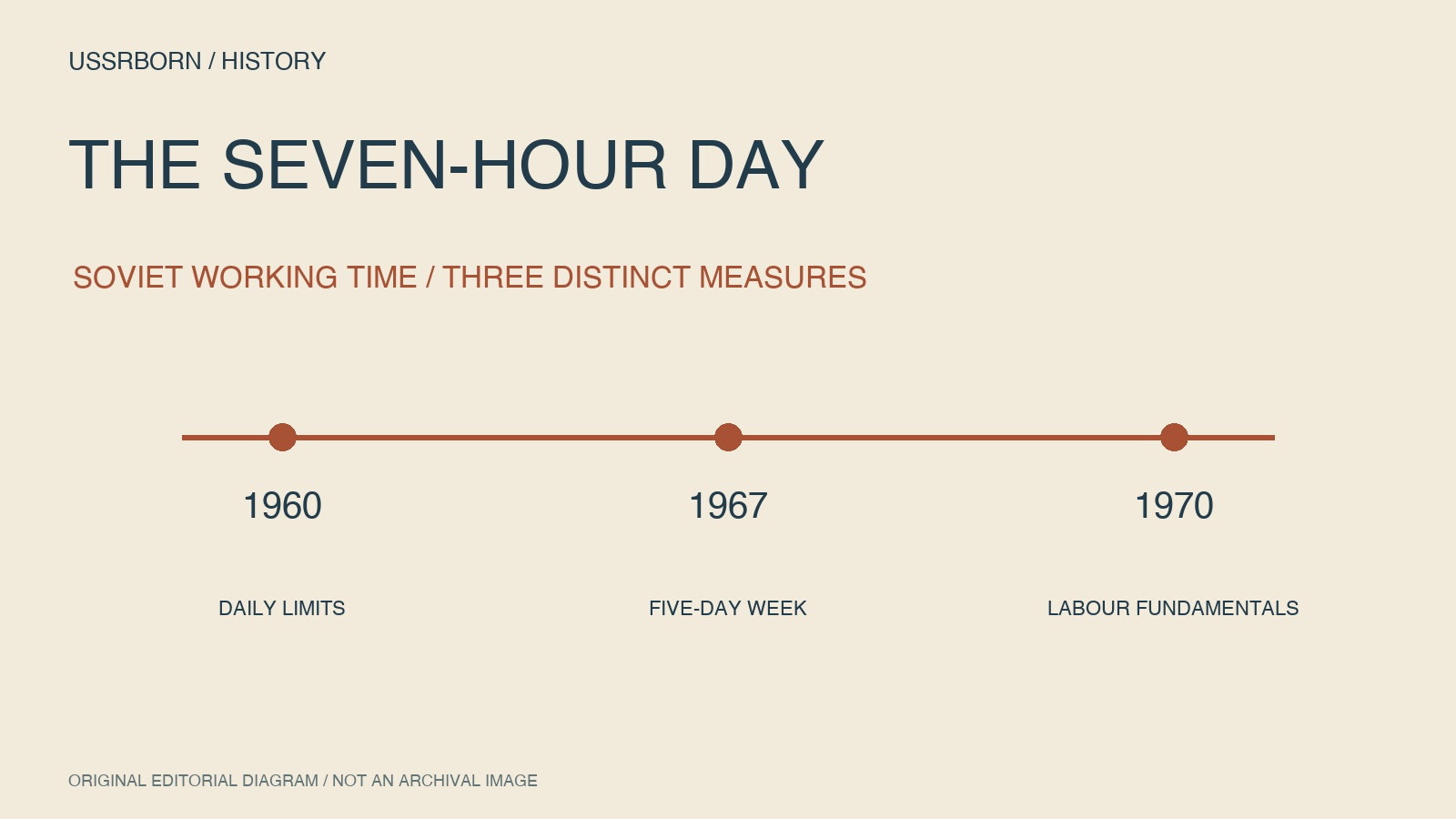
On 7 May 1960 the Supreme Soviet adopted a law completing the transfer of Soviet workers and employees to seven- and six-hour working days. It is easy to confuse this measure with the familiar five-day working week. The law addressed a different question: the maximum duration of daily work and the deadline for completing a transition already under way. A week with two days off was the subject of a separate reform in 1967.
What the 1960 law required
The document contained a preamble and two operative articles. The first endorsed measures already being implemented to shorten the working day and reorganise pay. The second set a daily maximum of seven hours for workers and employees, and six hours for workers in leading occupations employed underground. The transition was to be completed during 1960.
The word “complete” matters. The law did not describe every enterprise changing its timetable simultaneously on the morning of 8 May. It established an end date for a process in progress. To determine when a particular factory changed its schedule, a researcher would need the enterprise's orders and implementation records.
Its coverage also needs careful wording. The text referred to workers and employees. That does not establish an identical schedule for every Soviet resident, including all collective-farm members. The later Fundamentals of Labour Legislation treated the regulation of labour in collective farms and other cooperative organisations separately.
Why the six-hour limit was not universal
The second article tied the six-hour limit to leading occupations in underground work. It did not prescribe a six-hour shift for every industrial worker. The phrase “not more than” also matters: the law imposed a ceiling rather than prohibiting shorter hours.
Different groups could have different limits. The later Fundamentals separately provided reduced working time for younger employees, people working in harmful conditions and certain professions. A single figure cannot describe the entire Soviet working population.
The principle of maintaining wages
The preamble expressly stated that the reduction was being carried out without lowering wages. The intended benefit was additional time outside work without a corresponding reduction in earnings.
That principle should not be confused with an individual wage calculation. The law also mentioned the reorganisation of pay, but did not supply new rate tables for every industry. It cannot, by itself, establish the earnings of a particular machinist or clerk after a schedule change. That would require wage scales and payroll records rather than a simple proportional calculation based on hours.
Future targets and implemented rules
The preamble contained more ambitious objectives: a forty-hour week in 1962 and the beginning of a gradual move towards thirty to thirty-five hours from 1964. These were stated programme targets. Their appearance in a law does not prove that they became universal practice in the specified years.
Comparing legislation from different dates helps avoid that mistake. Article 21 of the 1970 Fundamentals of Labour Legislation, in the later published version consulted here, retained a normal maximum of forty-one hours a week. Further reductions were linked to the creation of the necessary conditions. The 1960 prospect of a shorter week should therefore not be rewritten as an accomplished nationwide thirty-hour norm.
How the five-day week differed
The resolution of 7 March 1967 concerned moving enterprises, institutions and organisations to a five-day week with two days off. This changed the distribution of work across the week. Shortening a shift and reducing the number of working days are distinct measures.
The Fundamentals make the distinction especially clear. On a five-day week, daily hours were established by internal rules or shift schedules within the applicable weekly limit. A six-day week retained specific daily ceilings, and work before the weekly day off was limited to six hours. As an illustration of the arithmetic, five seven-hour days plus one six-hour day total forty-one hours, not forty-two.
Reading memories of working hours
A recollection that “we worked seven hours” needs a date, occupation, workplace and number of working days. Shift length does not automatically reveal how many days off someone had. Time spent at a workplace may also differ from counted working time: the Fundamentals specified that an ordinary rest and meal break was excluded from working hours.
The significance of the 1960 law lies in its concrete provisions: a seven-hour ceiling, a particular underground-work exception, maintaining pay as a stated principle, and a deadline for completing the transition. Separating those provisions from the later five-day week and from prospective targets produces a more accurate account of everyday working life.