Mikhail Gorbachev: perestroika, glasnost and the end of the USSR
The last Soviet leader set out to save his country through reform — and ended up watching it vanish. Perestroika, glasnost, the end of the Cold War, and the most divided legacy of the century.
Who Gorbachev was
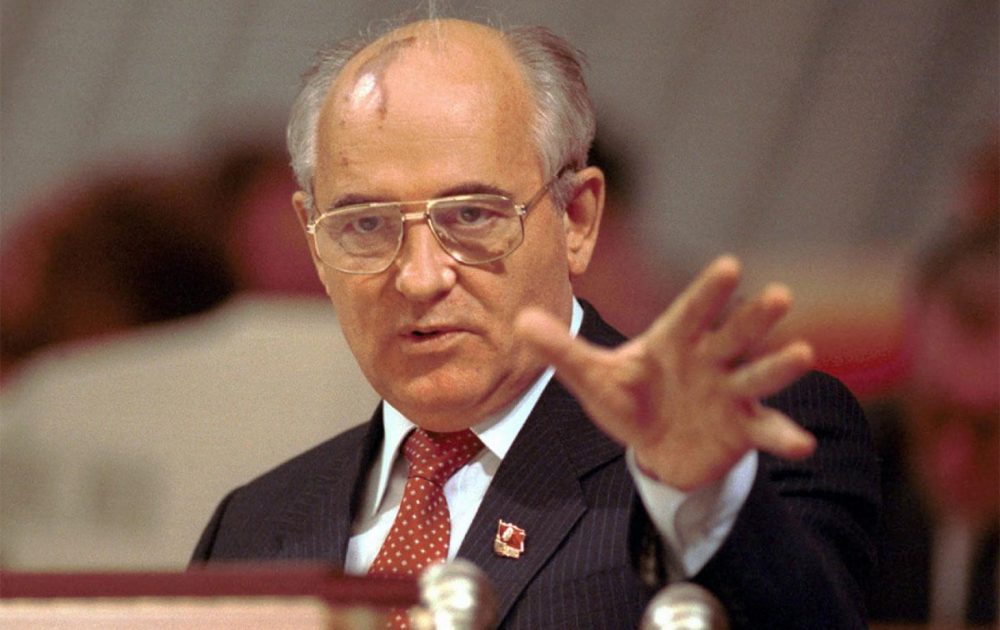
Mikhail Gorbachev was the last leader of the Soviet Union (1985–1991). He came to power to revive a frozen country through reform — and set in motion forces that changed the world: glasnost, perestroika, the end of the Cold War, the liberation of Eastern Europe. It all ended with something he had never planned: the disappearance of the USSR itself.
Opinions differ on no Soviet leader as sharply as on Gorbachev. In the West he is a peacemaker and one of the most respected figures of his age. At home, many hold him responsible for the country's collapse and the chaos of the 1990s. Both verdicts are part of an honest history.
From the village of Privolnoye
Mikhail Sergeyevich Gorbachev was born on 2 March 1931 in the village of Privolnoye in the Stavropol region, into a peasant family of Russian and Ukrainian roots. Stalin's steamroller did not spare the family: both his grandfathers were arrested during the repressions — and this, by Gorbachev's own admission, left a permanent mark on him.
As a teenager he worked as a combine harvester operator, and in 1952 he entered the law faculty of Moscow State University — a rare path for a village boy. There he met Raisa, the love of his life; their marriage would last until her death in 1999.
The ascent
After university Gorbachev built his career back in Stavropol, heading the regional party organization from 1970. In 1979–1980 he joined the Politburo — as its youngest member. He was promoted by Yuri Andropov, who saw in the energetic man from Stavropol the party's future.
After Brezhnev's death the country was led in turn by two elderly and ailing General Secretaries — Andropov and Chernenko, each for little more than a year. When Chernenko too died in March 1985, the Politburo placed its bet on youth.
March 1985: the youngest General Secretary
On 11 March 1985 Gorbachev was elected General Secretary of the Communist Party. He was 54 — next to the Kremlin elders he seemed a youth. He was the first leader of the country born after the revolution of 1917.
The inheritance was heavy: a stalling economy, the war in Afghanistan, the arms race, a general apathy. Gorbachev was convinced that socialism could be saved — if it was rebuilt.
Perestroika and glasnost
The two words of his era entered every language in the world.
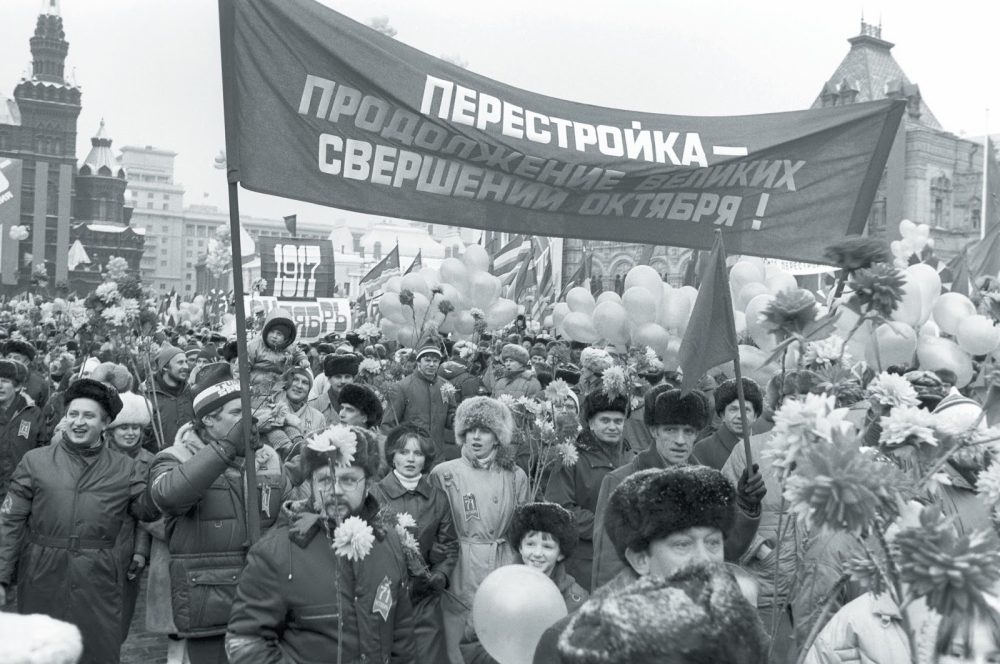
Perestroika ("restructuring") meant reforming the system: more independence for enterprises, elements of the market, the first cooperatives, an attempt to democratize the party itself. Glasnost ("openness") meant candour: the press was allowed to speak of problems, banned books returned from the locked archives, the country spoke openly for the first time about Stalin's terror, and dissidents came back from exile and the camps — in December 1986 Gorbachev personally telephoned Sakharov and brought him back from his exile in Gorky.
Not everything went smoothly: the anti-alcohol campaign launched in 1985 embittered people and blew a hole in the budget, while half-hearted economic reforms bogged down in the apparatus's resistance.
Chernobyl: the test of glasnost
In April 1986 the reactor at Chernobyl exploded. In the first days the authorities, from old habit, kept silent — and the catastrophe showed the price of secrecy. Gorbachev later admitted that Chernobyl was a turning point: after it, glasnost began to turn from a slogan into reality.
New thinking: the end of the Cold War
In foreign policy Gorbachev carried out a revolution he called "new thinking." He withdrew the troops from Afghanistan (completed in February 1989), and with US President Reagan held a series of historic summits — from Geneva and Reykjavik to the signing in 1987 of the INF Treaty on intermediate-range missiles: for the first time the superpowers did not merely limit but eliminated an entire class of nuclear weapons.
1989: the year the Wall came down
The decisive year was 1989. When the peoples of Eastern Europe rose against their regimes, Gorbachev did what none of his predecessors had done: he did not send the tanks. Poland, Hungary, Czechoslovakia and East Germany won their freedom one after another; in November 1989 the Berlin Wall fell, and soon Germany was reunited. The Cold War was ending — peacefully.
In 1990 Gorbachev was awarded the Nobel Peace Prize. One telling detail: according to polls, about 90% of Soviet citizens disapproved of the award — the West applauded, while at home resentment grew.
Democratization — and crisis
Inside the country the reforms gathered pace and slipped out of control. In 1989 the first genuinely competitive elections were held — and the country watched, transfixed, the live broadcasts of real political debate at the Congress of People's Deputies. In March 1990 Article 6, the party's monopoly on power, was removed from the constitution — the very thing Sakharov had demanded — and Gorbachev became the first (and last) President of the USSR.
But the economy was sliding downhill: shortages became total, and by the end of the decade rationing had returned. The republics declared their sovereignty one after another; in January 1991 blood was shed in Vilnius. The country was coming apart at the seams.
The August coup
On 19 August 1991 hardliners from Gorbachev's own circle tried to turn everything back: they formed the GKChP emergency committee, sent tanks into Moscow, and blockaded the president at his dacha in Foros, Crimea. But the people came out into the streets; the resistance at the White House was led by Boris Yeltsin, and some of the military went over to his side. Within three days the coup collapsed.
The plotters had wanted to save the USSR — instead they finished it off. The Communist Party was suspended, the republics declared independence in an avalanche, and real power passed to Yeltsin.
25 December 1991
On 8 December 1991 the leaders of Russia, Ukraine and Belarus declared that the Soviet Union was ceasing to exist (how the USSR broke apart). On 25 December Gorbachev delivered a farewell address and resigned the presidency. That same evening the red flag was lowered over the Kremlin. The country he had led no longer existed.
After the Kremlin
Gorbachev lived on for three more decades. He created the Gorbachev Foundation, worked on environmental causes, and in 1996 tried to return to politics in Russia's presidential election — winning less than one percent of the vote: his compatriots' verdict was eloquent. He even appeared in advertising (the famous pizza commercial), and criticized both the West and, in later years, the Russian authorities.
Mikhail Gorbachev died on 30 August 2022 at the age of 91. There was no state funeral; he was buried at Novodevichy Cemetery, beside Raisa.
The legacy: a hero there — a culprit here
The split in how Gorbachev is judged is itself a historical fact.
- To the West, and to many in Eastern Europe, he is a hero: the man who ended the Cold War peacefully, freed half of Europe and refused to shoot as the empire crumbled.
- To many in Russia he is the author of a catastrophe: a man who began reforms he could not control and lost the country — with all the humiliation and poverty of the 1990s that followed.
Gorbachev himself repeated to the end that he had wanted not to destroy the Union but to save it by giving people freedom. It turned out otherwise — and the argument over whether another path existed will not end soon. We give both sides.
Frequently asked questions
Who was Mikhail Gorbachev? The last leader of the USSR: General Secretary of the Communist Party (1985–1991) and the first President of the USSR (1990–1991). The author of perestroika and glasnost, and a Nobel Peace Prize laureate (1990).
What were perestroika and glasnost? Perestroika was the reform of the economy and political system (elements of the market, democratization). Glasnost was the policy of openness: freedom of speech and the press, and the truth about the past.
Did Gorbachev want to dissolve the USSR? No. He sought to reform and save the Union, but the reforms slipped out of control, and the 1991 coup accelerated the collapse.
What did Gorbachev win the Nobel Prize for? For his contribution to ending the Cold War and to peaceful change in Europe (1990). At home, by polls, about 90% of citizens disapproved of the award.
When did Gorbachev die? On 30 August 2022, at the age of 91. He is buried at Novodevichy Cemetery beside his wife Raisa.
Related
- The dissolution of the USSR (1991) — how perestroika ended.
- Chernobyl (1986) — the catastrophe that became the test of glasnost.
- Andrei Sakharov — the dissident Gorbachev brought back from exile.
- Leonid Brezhnev — the era of stagnation he inherited.
- The Berlin Wall: 28 years of the Cold War's greatest symbol — it fell in 1989, when he did not send the tanks.
- Perestroika and glasnost — a detailed look at his defining reforms.
Sources
The facts in this article can be verified against authoritative sources:
- Encyclopædia Britannica, "Mikhail Gorbachev": https://www.britannica.com/biography/Mikhail-Gorbachev
- Wikipedia, "Mikhail Gorbachev": https://en.wikipedia.org/wiki/Mikhail_Gorbachev
- PBS News, "Mikhail Gorbachev, leader of Soviet Union and 'perestroika' reform efforts, dies at 91": https://www.pbs.org/newshour/world/mikhail-gorbachev-leader-of-soviet-union-and-perestroika-reform-efforts
- EBSCO Research Starters, "Mikhail Gorbachev": https://www.ebsco.com/research-starters/biography/mikhail-gorbachev
- New World Encyclopedia, "Mikhail Gorbachev": https://www.newworldencyclopedia.org/entry/Mikhail_Gorbachev
Where assessments differ (saviour or author of the collapse), we give both positions rather than one.