The Moscow-Volga Canal: Water Supply, Locks and Dmitlag
Why the canal was built, how Volga water was lifted, what its opening dates mean and how forced labour contributed to construction.
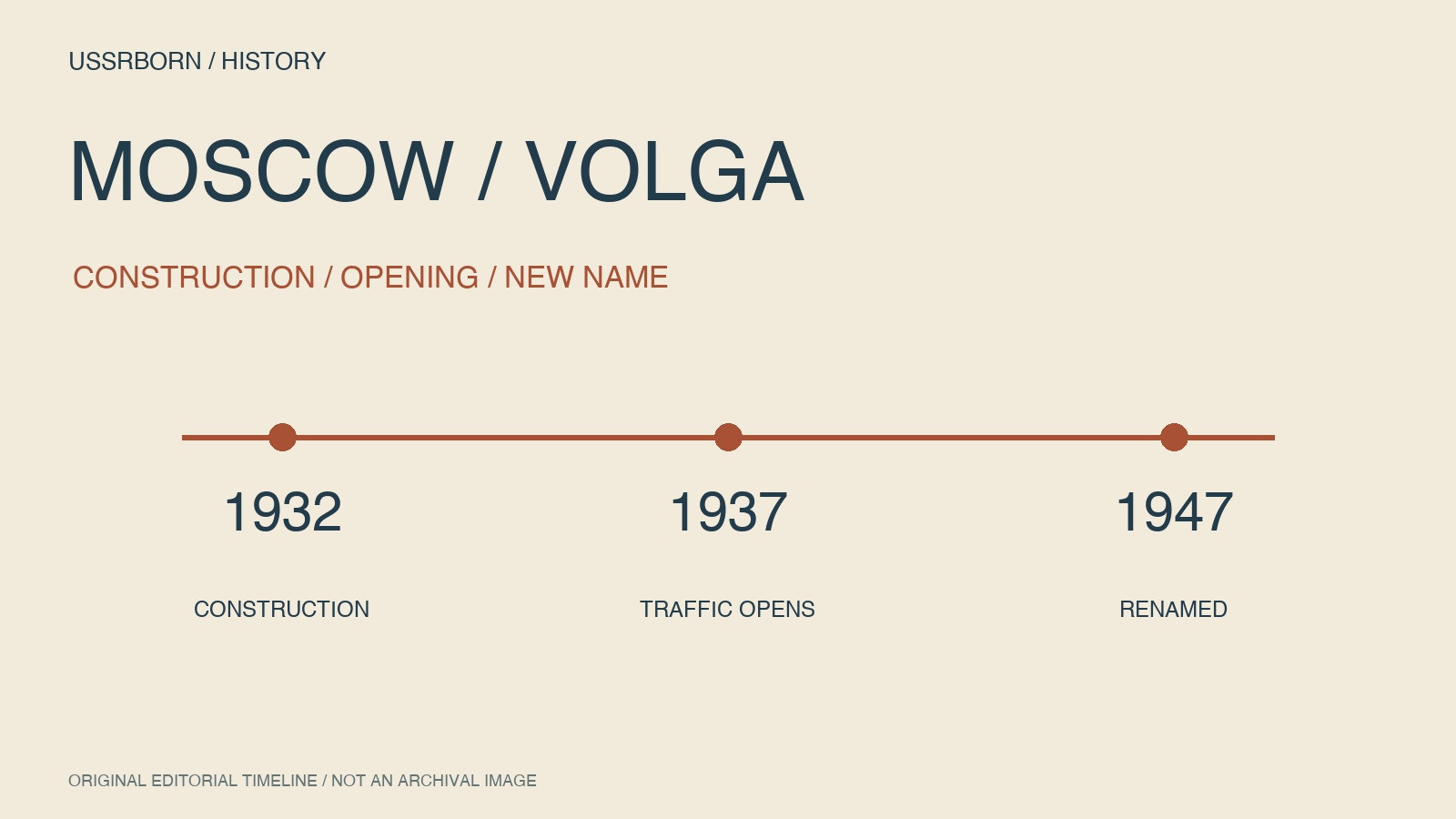
The Moscow-Volga Canal opened to passenger and freight traffic on 15 July 1937. It gave the capital a waterway to the Volga and a new source of water. Behind the ceremonial image of a major construction achievement lay another part of its history: extensive use of forced labour supplied through Dmitlag.
Why Moscow needed Volga water
The Presidential Library connects the decision of 1931 with the expansion of the city and industry. Construction began in autumn 1932. The first vessels were already travelling the route in spring 1937: a flotilla from Gorky arrived at the Northern Port on 2 May. The official opening to traffic followed in July.
Water supply and navigation addressed different needs. Residents and factories required water regardless of how many vessels passed through the canal. Shipping required a continuous route capable of carrying vessels across changes in elevation. The project therefore needs to be understood as a system of structures, rather than simply a long excavation.
Combining these functions helps explain its scale. Water supply supports the everyday operation of a city. A transport connection changes its position within a wider network of waterways. A ceremonial procession of ships illustrates the latter much more visibly than the former, but the opening spectacle tells only part of the story.
Why the water had to be lifted
The Museum of Maritime and River Fleet records a length of 128 kilometres. Water was raised in stages to the watershed section, making the canal dependent on energy rather than gravity alone. The entire route was filled on 17 April 1937. The canal received its Moscow name in 1947.
A pumping station and a lock perform different tasks. Pumps move water to a higher level. A lock enables a vessel to pass between reaches at different levels: the ship enters a chamber, the chamber's water level changes and the exit opens towards the next reach. The two operations belong to one system, but should not be confused.
A cross-section is more revealing than a line on a map. Where higher ground separates two rivers, digging a connecting channel is not enough. Water must be maintained at the upper level, and ships must negotiate the intervening steps. Distance alone therefore cannot explain the engineering demands. Elevation and the operating arrangements of the whole route matter too.
This is also why a canal's functions cannot be reduced to the visible movement of vessels. Water management continues to be a separate task. The channel, its controlled levels and its supply mechanisms make navigation possible; navigation is not itself the process that lifts the water.
Dmitlag and the construction workforce
The Dolgoprudny Historical and Art Museum describes the transfer of construction to the OGPU and the establishment of Dmitlag, centred on Dmitrov, in 1932. Both prisoners and hired workers were employed. The museum cites more than 22,000 prisoner deaths from the official data available to it. That is an attributed museum estimate, not a final independently established total presented here.
Historian N. Fedorov's account identifies the camp's founding order as dated 14 September 1932. It also describes a labour system extending beyond excavation to timber, peat and workshop activity. Supplying the construction operation itself required a substantial supporting workforce.
The coercive character of that system cannot be conveyed adequately by calling everyone a recruited worker. A prisoner did not have the ordinary freedom to choose employment or leave it. Conversely, the use of prisoners does not justify describing every engineer, employee or labourer associated with the canal as a prisoner. The categories need to remain distinct.
Figures for the workforce also require careful handling. The number held in a camp on a particular date is different from the total number who passed through it over several years. Combining the two produces comparisons that look impressive but do not measure the same thing. Deaths form a further, separate question; they cannot be inferred from the length of the canal or a general workforce total.
April, May and July describe different milestones
Accounts of 1937 refer to several dates because construction did not turn into operation in a single moment. Filling the route, receiving the first vessels and formally opening passenger and freight traffic were distinct stages. April, May and July do not need to compete as mutually exclusive answers.
This distinction is useful when reading historical photograph captions. An image of a vessel on the water can document a particular passage. Without additional information, it does not establish the date of the official opening. Similarly, a completed building facade does not demonstrate that an entire water system was already operating as intended.
The same approach avoids turning the canal's later name into its original one. A retrospective account can use the familiar name for clarity while explaining when the change occurred. Naming, construction and operation each have their own chronology.
Keeping the engineering and human histories together
The Moscow-Volga Canal was urban infrastructure, a transport connection and a project closely tied to the camp system. These descriptions concern different aspects of the same construction. Engineering explains how water and ships could cross the route. The history of Dmitlag explains a substantial part of the conditions under which it was built.
A useful account holds these perspectives together. It identifies the operational milestones, explains the purpose of the structures and names forced labour explicitly. That allows the opening of 1937 to be understood as more than a ceremony, without losing sight of what the canal was designed to do.